
16 Sep Pet Soft Chew Manufacturing Guide: Formula, Palatability, Texture and Packaging
Soft chews have become one of the most attractive dosage forms in the pet industry because they combine convenience, taste, texture, and functional benefits in a format that pet parents can easily understand. For dogs, cats, and other companion animals, a supplement is only useful if the animal is willing to consume it consistently. This is why soft chews are more than a simple treat-like product. They are a practical pet supplement form that can carry active ingredients, support daily health needs, and create a better administration experience for pet owners.
For brands, distributors, and private label customers, functional dog soft chews offer a strong business opportunity. The pet supplement category is one of the fastest growing markets in the broader pet industry, and soft chews are especially suitable for products designed to support joint health, digestive health, skin and coat care, calming, anxiety support, immune wellness, urinary support, and daily vitality. Compared with liquid products, capsules, powders, or tablets, chews can be easier for pet owners to give and easier for pets to accept.
However, developing high quality soft chews is not only about making a tasty product. A reliable dog soft chew manufacturer must consider formulation, active ingredients, excipients, flavor, api solubility where relevant, texture, softness, weight consistency, shapes, packaging, production process, heat exposure, storage conditions, quality compliance, and shelf-life performance. A soft chew must be palatable, stable, convenient, and suitable for the intended animals. If one of these factors is ignored, the finished product may look attractive at first but fail during real use, shipping, storage, or repeat purchase.
This article explains how soft chews are developed from a B2B manufacturing perspective. It covers why this dosage form is valuable, how formula and texture influence product success, and what brands should evaluate when choosing a private label soft chew manufacturing partner.
Why Soft Chews Are a Practical Pet Supplement Dosage Form for Companion Animals
Soft chews are popular because they sit between a functional supplement and a treat-like experience. Many dogs resist capsules or hard tablets, and some pet owners find powders or liquids messy to use every day. A soft chew solves this problem by giving pet parents a familiar and convenient format. It looks like something the pet wants to eat, but it can still be formulated with active ingredients that support specific health goals.
For companion animals, taste and texture are not minor details. They are key product success factors. A formula may contain high quality ingredients, but if the dog refuses to eat it, the benefits cannot be delivered. This is especially important for daily pet supplement products that need consistent use over time. Joint support soft chews, digestive support chews, calming chews, and skin and coat chews are usually not one-time products. They are designed to become part of the pet’s daily routine.
Soft chews also give brands more room for product storytelling. A private label product can be developed around unique benefits, such as mobility support for active dogs, digestive balance for sensitive pets, calming support during stress, or skin and coat vitality for pets needing omega-rich ingredients. The chew format helps make the product more approachable and less clinical. For many pet owners, a soft chew feels easier and more caring than forcing a capsule or mixing a powder into food.
Soft Chews Combine Pet Supplement Function with Treat-Like Palatability
The biggest reason soft chews work well is palatability. Dogs and cats respond strongly to aroma, flavor, texture, and mouthfeel. A soft chew should be tasty enough to encourage voluntary consumption, but it must also remain consistent enough to deliver the intended amount of active ingredients. Palatability is not only about flavor. It also includes softness, chew feel, shape, size, moisture balance, and how the product breaks down when the animal eats it.
A well-formulated soft chew may use flavor systems, binding ingredients, humectants, oils, proteins, fibers, and other excipients to create a soft and appealing texture. The challenge is to balance taste with function. Some active ingredients have bitter notes, strong odors, or poor compatibility with certain bases. For example, glucosamine may be used in joint support chews, probiotics may be used in digestive formulas, and botanical ingredients may be used in calming or anxiety support products. Each ingredient can influence flavor, texture, and stability.
A soft chew should not be too hard, because then it starts to feel like a tablet. It should not be too sticky, because that creates poor handling and packaging problems. It should not be too dry, because pets may reject it and the product may crumble during transportation. It should not be too oily, because oil migration can affect appearance, packaging, and shelf life. A good dog soft chew manufacturer must understand how to create the right mixture and preserve the product’s quality over time.
Why Private Label Brands Choose Soft Chews for Dogs and Cats
Private label brands choose soft chews because they are flexible, marketable, and easy to build into a product line. A brand can start with one formula, such as joint support soft chews with glucosamine, then expand into digestive health, skin and coat, calming, immune support, or multifunctional formulas. This makes soft chews useful for companies that want to develop a complete pet supplement portfolio.
Soft chews also allow customization in flavor, shape, weight, packaging, and formula direction. The product can be developed for dogs, cats, or broader companion animals, although cats often require more careful palatability work. For dogs, common chew weights may vary depending on the formula and target body size. Smaller chews may suit daily wellness or lighter functional products, while larger chews may suit formulas that require higher levels of active ingredients.
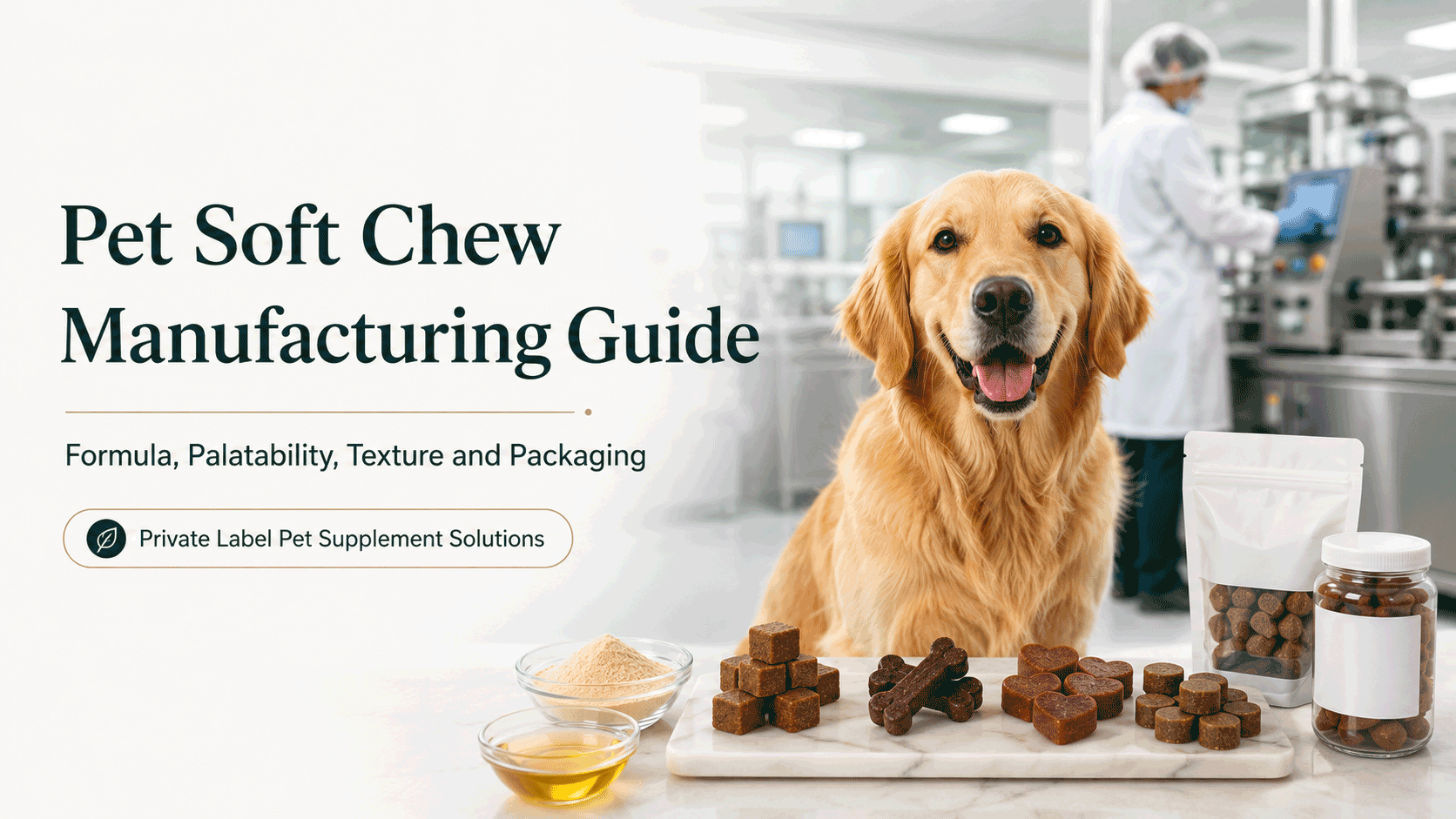
For private label customers, visual differentiation is also important. Soft chews can be made in different shapes, such as cubes, hearts, bones, rounds, or custom shapes. Shape may not directly change the health benefit, but it can enhance brand identity and consumer appeal. When combined with custom packaging, clear label design, and a strong product concept, the soft chew becomes more than a generic supplement. It becomes a branded product experience.
How a Dog Soft Chew Manufacturer Develops Formula, Palatability and Texture
The quality of a soft chew starts with formulation. A good formula must do several things at once. It must carry active ingredients, remain palatable, preserve texture, support production efficiency, stay stable during storage, and meet quality and compliance requirements. This makes soft chew manufacturing more complex than simply mixing ingredients and forming pieces.
A dog soft chew manufacturer must evaluate the behavior of each ingredient. Some ingredients affect softness. Some absorb water. Some release oil. Some are sensitive to heat. Some change flavor. Some influence color. Some create challenges during production. Even small changes in the formulation can affect final texture and consistency.
For pet supplement products, the term active ingredients usually refers to functional nutrients, botanicals, probiotics, oils, vitamins, minerals, amino acids, or other ingredients that provide the main product positioning. The term active pharmaceutical ingredients, or API, should be handled carefully because APIs belong more directly to veterinary medicine and regulated drug products. If a project involves active pharmaceutical ingredients, it requires strict regulatory review and cannot be treated like an ordinary pet supplement. In most private label supplement projects, brands should focus on compliant active ingredients suitable for pet wellness products.
Formula Design: Active Ingredients, Excipients and Stability
Formula design begins with the product goal. A joint support soft chew may include glucosamine, chondroitin, MSM, collagen, or omega-rich ingredients. A digestive health soft chew may include probiotics, prebiotics, fibers, or enzymes. A skin and coat formula may use salmon oil, omega fatty acids, biotin, or other nutrients. A calming chew may use ingredients positioned for stress or anxiety support, but the language should remain careful and not imply treatment of medical conditions.
Once the goal is clear, the formulation team must determine whether the active ingredients can survive the manufacturing process and remain stable in the finished product. Heat can be a major issue for sensitive ingredients. Probiotics, certain vitamins, oils, and botanical compounds may be affected by production conditions. If the process exposes the mixture to high heat or moisture, the manufacturer needs to adjust the formula, choose more stable ingredient forms, or use a process that better protects the actives.
API solubility can also matter in specialized projects, especially when ingredients need to be evenly distributed in a soft matrix. Even in non-drug pet supplement products, solubility, particle size, oil compatibility, and ingredient dispersion can affect consistency. A chew must deliver a reasonably uniform dose from piece to piece. If active ingredients are not evenly mixed, some chews may contain too much while others contain too little.
Excipients are essential to soft chew quality. They help create structure, softness, moisture control, flavor release, and handling properties. A good manufacturer does not treat excipients as filler only. They are part of the product technology. The right excipient system can help preserve softness, reduce crumbling, manage stickiness, and support shelf life.
Palatability and Texture: Why Taste, Softness and Chew Feel Matter
Palatability is one of the most important factors in soft chew development. Pet parents may buy the product once because of the label, but they will only buy again if their pets accept it. A tasty product with good texture can improve daily compliance and repeat purchase. A product that smells unpleasant, feels too hard, or leaves residue in the package may fail even if the formula looks strong on paper.
Flavor selection should suit the target animals. Dogs may respond well to meat, poultry, cheese, liver, peanut butter, or other savory profiles. Cats can be more selective and may require stronger attention to aroma and mouthfeel. The flavor system should also mask unpleasant notes from active ingredients. Some ingredients used for joint support, digestive support, or calming formulas may have strong tastes that need careful balancing.
Texture must be controlled from production to storage. The soft chew should remain soft enough for easy consumption, but solid enough to keep its shape. It should not collapse, melt, harden, or become sticky in normal storage conditions. This is where moisture level, water activity, binding system, fat content, and packaging all work together.
Consistency is also important. Private label customers expect each batch to look and feel similar. Pet owners expect each chew to have the same size, shape, taste, and softness. If one batch is soft and another is dry, customers may lose trust in the brand. A reliable dog soft chew manufacturer should control production parameters carefully and provide quality checks during and after manufacturing.
Packaging, Shelf Life and Private Label Options for Pet Soft Chews
Packaging is not just the final step of soft chew manufacturing. It is part of the product design. The right packaging helps preserve texture, flavor, active ingredient stability, and visual quality. It also communicates the brand’s value to pet owners. For private label pet supplement products, packaging can determine whether the product looks premium, practical, natural, clinical, playful, or affordable.
Soft chews are sensitive to the storage environment. If packaging does not protect the product well, chews may dry out, absorb moisture, become sticky, lose aroma, change color, or experience oil migration. Some active ingredients may also degrade if exposed to oxygen, light, moisture, or heat. This is why packaging decisions should be made early, not after the formula is finished.
Common packaging options include jars, pouches, tubs, and flexible bags. Each form has advantages. Jars are convenient for daily home use and create a solid retail presence. Pouches can reduce shipping weight and support e-commerce. High-barrier packaging may help protect sensitive formulas. The best choice depends on product count, chew size, active ingredients, target market, and brand positioning.
Packaging Choices for Soft Chews: Jars, Pouches and Custom Shapes
For private label brands, packaging must balance protection and marketing. A premium soft chew product may use a sturdy jar with a clean label and strong shelf appeal. A value-oriented product may use a flexible pouch to reduce cost and improve shipping efficiency. A travel-friendly product may use smaller packs or sachet-style formats. The packaging should suit the product’s dosage form and the expectations of the target customers.
Custom shapes can also support brand identity. A bone shape may feel familiar for dog products, while a heart shape may suit wellness and care positioning. A cube or round shape may look cleaner and more modern. The shape should be attractive but also practical. Complex shapes may look good in photos but create production challenges, breakage risk, or uneven weight if not designed well.
The packaging should also provide enough space for clear instructions. Pet owners need to know how many chews to give, how to store the product, which animals the product is intended for, and when to consult a veterinarian. If the product is for dogs only, that should be clear. If it is suitable for dogs and cats, the serving guidance must be carefully developed. Labels should avoid overclaiming and should use compliance-friendly language.
Shelf Life, Quality Control and Private Label Manufacturing Support
Shelf life is one of the most important details in soft chew manufacturing. A product may look perfect after production, but it must remain acceptable throughout its intended storage period. This means the manufacturer should evaluate softness, taste, odor, color, microbial quality, active ingredient stability, and packaging compatibility over time.
Quality control should include checks for weight consistency, appearance, moisture, texture, and packaging seal integrity. Depending on the formula, additional testing may be needed for active ingredients, microbial limits, heavy metals, or other quality factors. A good manufacturing partner should maintain batch records, quality documents, and retained samples. These details help protect the brand and support customer confidence.
Private label support should also include more than production. Many customers need help with formula development, sample adjustment, packaging selection, label direction, and product positioning. A strong partner will ask about the target animals, target market, active ingredients, desired chew weight, flavor preference, packaging plan, and compliance needs before production begins.
For companies entering the pet supplement business, this support can be essential. A brand may know that it wants to create functional dog soft chews, but it may not know which formula, flavor, texture, or packaging will work best. An experienced team can help customers learn the details, determine the right development path, and avoid costly mistakes.
Looking for a Dog Soft Chew Manufacturer?
Choosing the right dog soft chew manufacturer is a strategic decision for any pet supplement brand. Soft chews are one of the most practical dosage forms for companion animals because they combine function, taste, convenience, and daily use potential. They can support many product directions, including joint support, digestive health, calming support, skin and coat vitality, immune wellness, and multifunctional pet health formulas.
However, soft chew development requires real expertise. The manufacturer must understand formulation, active ingredients, excipients, flavor systems, texture, softness, heat sensitivity, production consistency, packaging, storage, and quality compliance. It must also understand the expectations of private label customers, pet parents, and pet owners.
A high quality soft chew is not created by chance. It is the result of careful formula design, palatability work, stable production, suitable packaging, and a commitment to quality. For brands that want to develop private label soft chews, the right partner can provide access to technical knowledge, product development services, packaging support, and scalable production.
As demand for pet supplement products continues to grow, soft chews will remain a key form in the pet industry. Brands that create palatable, stable, convenient, and well-positioned soft chews can build stronger customer trust and long-term business value. For dogs, cats, and companion animals, a well-developed soft chew can make daily supplement administration easier. For brands, it can become a strong foundation for a successful private label pet supplement line.