
24 Dec Exporting Pet Supplements from Asia Challenges and Strategies for Success
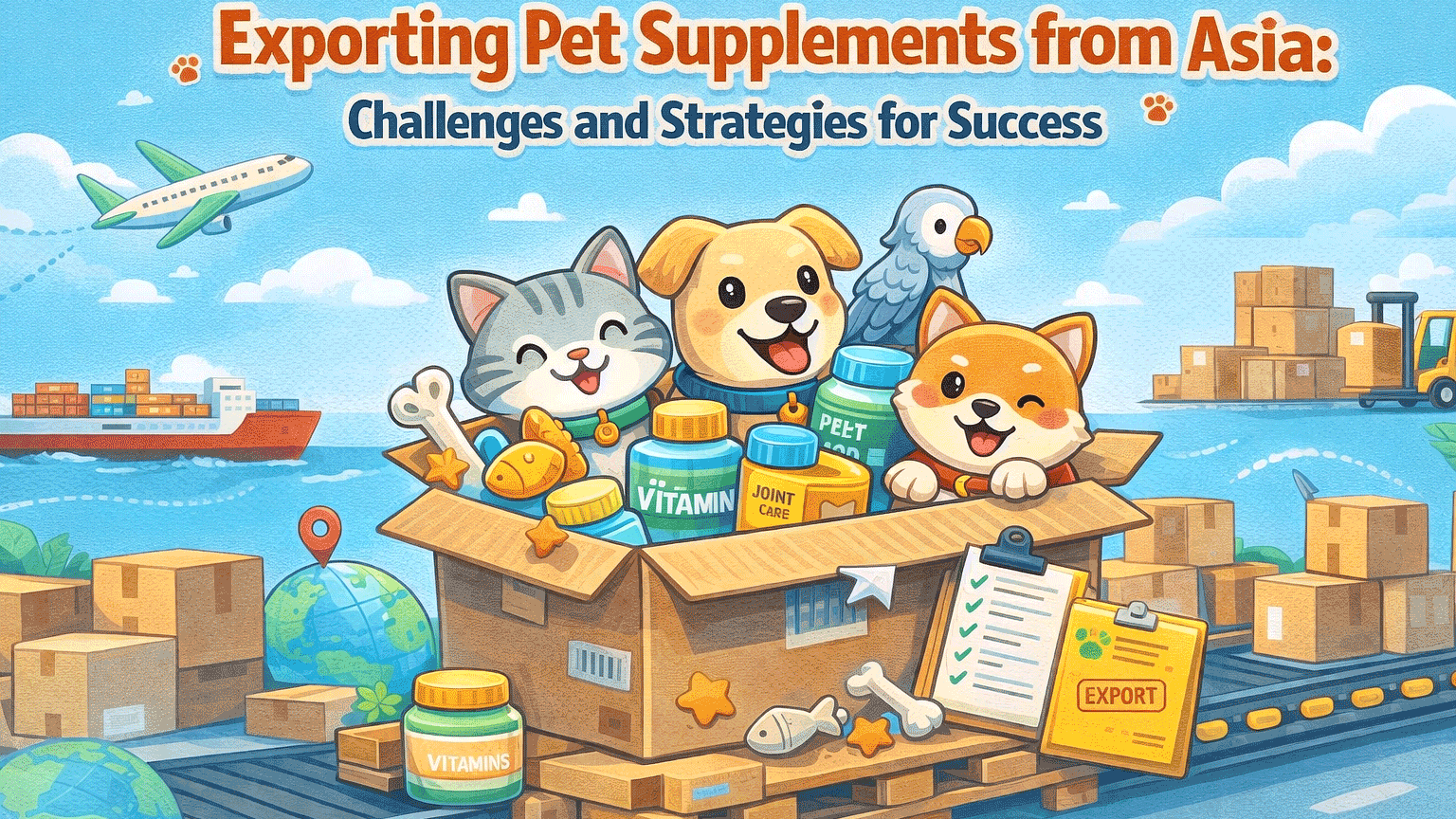
Exporting Pet Supplements from Asia: Challenges and Strategies for Success
As Asia and Southeast Asia become increasingly important manufacturing regions for pet supplements and pet nutrition products, more companies are exploring opportunities to export pet food, pet treats, and animal health products to international markets. The rapid rise of global pet ownership, combined with rising interest in natural pet supplements, has created significant demand worldwide. However, exporting pet supplements is far more complex than producing them. Exporters must navigate a wide range of regulatory, documentation, certification, and logistics requirements that differ from one importing country to another.
To succeed in international trade, companies must understand how pet supplements are regulated, how export certificates are issued, what documents are necessary for animal origin products, and how to comply with food safety, federal food, and cosmetic act requirements. They must also address cultural and religious expectations, shipping requirements, and evolving standards in overseas markets.
This guide provides a detailed export framework for Asian manufacturers and distributors, helping them plan efficiently, avoid regulatory mistakes, and accelerate global expansion.
1. Understanding Global Regulatory Requirements for Exporting Pet Supplements
1.1 Ingredient and Labeling Compliance
One of the most important challenges when exporting pet supplements is ingredient and labeling compliance. Every importing country has its own definition of pet food, pet supplements, animal products, dairy products, plant products, and ingredients of animal origin. Some ingredients that are legally permitted in one market may be restricted or require prior notice in another.
For example, pet supplements that contain meat products, bone meal, dairy derivatives, animal fat, fish oil, or ingredients from animal by-products must often undergo a veterinary health certificate assessment before export. The importing country needs to verify that animal-based ingredients are free from livestock diseases or exotic pathogens. This means formulations must be reviewed before production and labeling must match the accepted naming standards set by the local regulatory agency.
In addition to ingredient approval, exporters must meet country requirements for product labeling, including nutrient guarantees, ingredient lists, storage conditions, manufacturer address, batch number, safety warnings, and additional information regarding intended use. Failure to meet labeling rules can result in shipment rejection, customs delays, or a requirement to relabel products under supervision.
Ingredient transparency is increasingly important in international markets. Some countries require clear indication of whether a product is natural, free from artificial additives, or from certain animal origin products. Exporters should therefore perform regulatory research before beginning formulation and ensure labels comply with the exact standards of each target market.
1.2 EU Feed Additive Regulations
The European Union governs pet dietary supplements under strict feed additive regulations rather than under a traditional dietary supplement framework. EU Regulation 1831/2003 establishes permitted additives, maximum inclusion limits, product registration requirements, and a uniform system for evaluating safety and efficacy. Under this regulatory model, pet supplements are treated as animal feed products and are subject to stringent safety and hygiene controls.
To export pet supplements to Europe, companies must ensure:
All additives are approved under the EU feed additive register
Maximum limits are respected for specific functional ingredients
The product is registered or notified where required
Labels accurately state usage conditions, recommended feeding rates, and intended purpose
Additionally, some EU member states may require local language labeling, shelf-life validation, and packaging modification to meet regional standards. A product compliant in one EU country is generally accepted across the Union, but importers may still request additional documentation before customs clearance.
Failure to comply may result in shipment rejection, delayed customs release, or fines. Exporters therefore need strong quality assurance and regulatory expertise when entering the European market.
1.3 FDA and AAFCO in the United States
In the United States, pet supplements fall under the jurisdiction of the Food and Drug framework and must meet requirements under the Federal Food, Drug, and Cosmetic Act (FD&C Act). Although pet supplements are not regulated as human dietary supplements, they must meet ingredient safety standards and avoid disease treatment claims.
Ingredient definitions established by AAFCO guide acceptable formulations for pet food and pet supplements. Certain functional ingredients—especially those relating to joint health, digestion, or immune function—must adhere to AAFCO approval or GRAS (Generally Recognized as Safe) standards. Some ingredients are considered food additives and require formal review, especially when the ingredient comes from animal origin.
Labels must include clear usage instructions, feeding recommendations, guaranteed analysis, storage conditions, and identity statements such as “for animal use only.” Labels must avoid misleading claims or wording that turns a product into a veterinary drug by implying disease prevention or cure.
Additional information is sometimes required on labels for animal products or dairy ingredients, especially when the importer must verify safety or intended用途. Adherence to FDA labeling rules prevents regulatory action and accelerates customs clearance.
2. Export Documentation, Certification and Compliance
2.1 Export Certificates and Veterinary Health Documents
International pet supplement shipments require proper export certificates, especially for products containing ingredients derived from animals. The Animal and Plant Health Inspection Service (APHIS) or equivalent Asian agency is the agency responsible for verifying that exported animal origin products are safe and free from disease.
For U.S. exporters, the Veterinary Services VS Form (certificate number varies by product type) is one of the most recognized health documents. It confirms that pet supplements, pet food, dairy products, or meat products meet the importing country’s sanitary and animal health requirements. Many foreign governments require a veterinary health certificate before accepting pet supplements containing livestock-derived additives.
Key examples of required certificates include:
Health certificate for meat products
Health certificate for dairy products
Sanitary certificate for animal by-products
Inspection documents for plant products or agricultural ingredients
The importing country may request certificates verifying the absence of livestock diseases or livestock diseases exotic to their region. Exporters must verify exact country requirements, as certification formats can vary widely.
Pet supplements without animal ingredients may require fewer formal certificates, but many importing countries still require documentation regarding product identity, origin, batch numbers, processing conditions, and facility registration.
2.2 Other Federal Agencies and Certification Bodies
In addition to APHIS or equivalent veterinary agencies, other federal agencies or ministries may be involved in export certification. For example, some products may be considered FDA regulated products, requiring prior review for ingredient safety and labeling compliance. The inspection service may also involve customs agencies, plant health offices, bioterrorism monitoring bodies, and agencies responsible for food safety enforcement.
Some shipments may require:
Importer confirmation of prior notice under the Bioterrorism Act
Inspection or sampling before shipment
Facility or warehouse visits
Safety declarations regarding contaminants or heavy metals
Dioxin or pesticide statements, even if not originally required
Regulatory expectations vary widely. An importing country may suddenly ask for additional information, even if products have cleared customs before. Exporters must maintain compliance systems capable of issuing updated certificates quickly.
2.3 Market-Specific Compliance Challenges
Exporters must understand that importing country requirements differ dramatically. A product legal in the United States may not be accepted in the European Union without reformulation. Southeast Asian markets may require Halal certification for animal origin products. The Middle East may require specific religious or ingredient declarations.
To reduce risk, exporters should:
Obtain full ingredient pre-clearance before manufacturing
Prepare health certificates and export documentation early
Follow the importer’s instructions for customs clearance
Anticipate long processing times for registration, especially for functional ingredients
Navigating fragmented regulations is one of the most difficult parts of exporting pet supplements. Companies that fail to understand market nuances often face delays, product seizures, or relabeling orders at the port of entry.
Strengthening Global Pet Food and Supplement Export Success
Exporting pet food and pet supplements from Asia offers enormous opportunities, but it also requires strict compliance with international regulations, detailed documentation, and consistent quality systems. As global demand grows, manufacturers must be prepared to treat every product containing animal or agricultural products as products regulated under the importing country’s laws. Successful exporters understand that compliance begins early—from formulation and ingredient selection to packaging, labeling, and export paperwork.
Health certificates, APHIS plant protection procedures (or equivalent Asian regulatory frameworks), and veterinary products documentation are increasingly important for international trade. Exporters must be able to demonstrate product safety, facility hygiene, and disease-free status for any animal origin products. Before shipment, companies must verify import requirements, secure export certificates, and ensure all documentation is aligned with real-time customs expectations. In many cases, the importer confirms compliance before the products are shipped to avoid delays or seizure at the port of entry.
The global pet nutrition sector will continue to evolve, and countries are expanding their oversight of ingredients, additives, and veterinary supplements. Companies that proactively strengthen regulatory strategies, maintain well-organized documentation systems, and build transparent communication with international authorities are better positioned to grow. In this evolving landscape, thorough preparation and disciplined execution are the cornerstones of successful pet food and pet supplement exports—and companies that treat compliance as a strategic asset will unlock long-term global market advantages.